
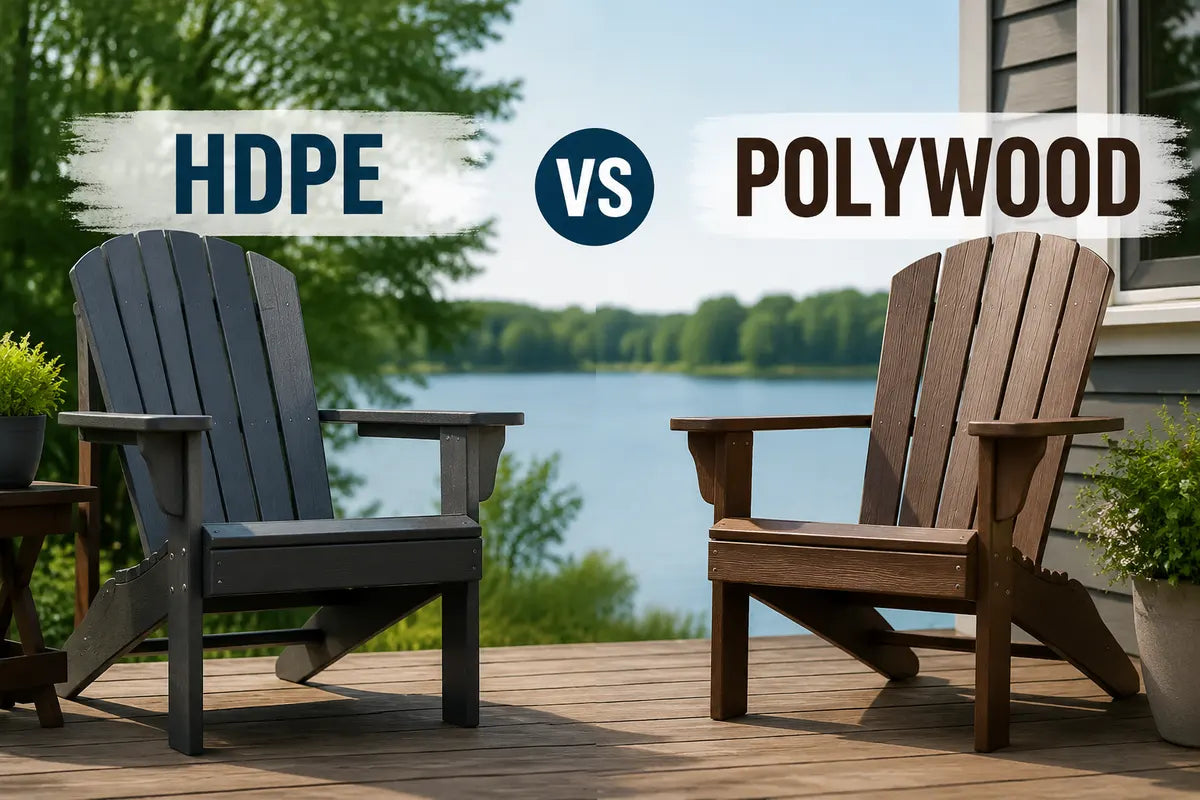
Shopping for outdoor furniture, you keep seeing both terms used almost interchangeably. It's not clear if you're comparing two different materials, or the same thing with two names. HDPE vs Polywood, what's actually going on here? This guide covers what each term means, how they relate, where the two commonly differ in practice, and how to decide between generic HDPE and Polywood specifically.
What Is HDPE Material?
HDPE, short for high density polyethylene, is a type of plastic used across many industries, including outdoor furniture. It's dense and durable, which is why it holds up well outside without cracking, rotting, or absorbing water the way wood can.
Most HDPE furniture is made from recycled plastic, commonly old milk jugs and detergent bottles. Manufacturers grind it down and reprocess it with UV protection and color mixed all the way through, then shape it into lumber-style boards. From there, it gets built into chairs, tables, and benches using the same basic joinery techniques used in woodworking.
Dozens of companies build HDPE outdoor furniture, from large national brands to smaller manufacturers like Patio Kingdom. It's a material category, not any single brand or product line.
What Is Polywood Material?
Polywood is a specific company that manufactures outdoor furniture, and it happens to build that furniture from HDPE. It's one of the more widely recognized names in the category, with a broad product lineup.
Its name recognition is why plenty of shoppers use "Polywood" as shorthand for HDPE outdoor furniture in general, whether or not that's the specific brand they mean. It's the same pattern as saying "Xerox" for photocopying or "Kleenex" for tissues. That familiarity is part of why the name shows up so often in furniture searches, even when the shopper is really just looking for HDPE furniture broadly.
Is Polywood the Same as HDPE?
Polywood furniture is HDPE furniture. But not all HDPE furniture is Polywood. That's the core relationship: HDPE is the raw material, and Polywood is one manufacturer among many that builds with it.
Asking "HDPE vs Polywood" is a bit like asking wood vs a specific furniture brand that builds with wood. The material and the brand aren't competing categories. There isn't really a choice to make at the material level.
The real differences show up further down the line, in how each manufacturer sources, processes, and builds with that shared material. That's where quality, price, and warranty terms start to diverge.
HDPE vs Polywood: How Do They Compare?
Since the underlying material is the same, the real differences between Polywood and other HDPE brands come down to business and manufacturing choices, not the plastic itself.
Price
Price is the most consistent difference shoppers notice. Polywood's brand recognition and marketing generally carry a premium that lesser-known HDPE brands don't charge, even when the build quality is comparable. Generic HDPE brands are often priced lower for similar pieces. That gap narrows, or disappears, with some higher-end HDPE manufacturers.
Durability and Warranty
Durability is harder to generalize, since it depends on execution rather than the brand name. A well-made piece from a smaller HDPE brand can match or exceed Polywood's performance. A poorly made one won't come close.
Polywood commonly backs its residential furniture with 20-year warranties. Warranty length among other HDPE brands varies much more widely, from just a couple of years to 20 or more. Reading warranty terms and checking material thickness in product photos is a more reliable way to judge durability than the brand name alone.
Color and Style Options
Polywood offers a wide, consistent range of colors and styles across its product lines, since everything comes from one manufacturer with unified production standards. Other HDPE brands vary more here, whether it's HDPE outdoor chairs or full dining sets. Some offer just as much variety, while smaller manufacturers may stick to a narrower set of colors or styles.
Availability
Polywood is sold through major retailers as well as its own website, so it's easy to find and compare in person or online. Generic HDPE brands are more often sold direct-to-consumer or through smaller retailers. That can mean fewer chances to see the furniture in person before buying.
Here's how those four factors stack up side by side:
| Factor | Polywood | Generic HDPE brands |
|---|---|---|
| Price | Typically higher, reflecting brand recognition | Often lower for comparable build quality |
| Warranty | Commonly 20 years on residential furniture | Varies widely, from a few years to 20+ |
| Color and style | Wide, consistent range across product lines | Ranges from just as wide to more limited |
| Availability | Major retailers and its own website | Often direct-to-consumer or smaller retailers |
Which Should You Choose: HDPE or Polywood?
The right choice depends more on what you value than on any performance gap between the two, since both ultimately use the same base material.
Polywood tends to be worth the premium when:
- You want to match furniture across multiple purchases over time
- Brand consistency and a long track record matter to you
- You'd rather have the reassurance of widely available customer support
- Its long warranty terms would give you peace of mind if something goes wrong
The calculation flips the other way for shoppers who'd rather put that premium toward something else. Generic HDPE brands make more sense when:
- Budget is a priority over brand recognition
- You're willing to research a specific manufacturer's reputation and warranty terms
- You want comparable build quality without paying for marketing costs
- You're comfortable checking reviews and warranty length yourself, rather than assuming a lower price means lower quality
The Bottom Line
HDPE vs Polywood isn't really a competition between two materials, since Polywood furniture is HDPE furniture built by one specific manufacturer. The real comparison is between Polywood's brand consistency and premium pricing, and the wider range of quality and price you'll find among other HDPE brands. Neither choice is automatically better. It depends on whether you're paying for a known name or looking for the best build quality at the lowest price. Either way, checking specifics like warranty length and board thickness matters more than the brand name.
FAQ
Is Polywood better than regular HDPE furniture?
Not inherently. Polywood is a well-regarded brand with a strong track record and long warranties, but it's built from the same HDPE material other manufacturers use. Some HDPE brands match or exceed Polywood's quality at a lower price, so it's worth comparing warranty terms and material thickness rather than assuming the brand name guarantees better quality.
Why is Polywood more expensive than other HDPE furniture?
Polywood's higher price generally reflects brand recognition, marketing, and wide retail distribution rather than a fundamentally different material. Its consistent quality control and long warranty history also factor into the price. Lesser-known HDPE brands can offer comparable materials at lower prices since they carry fewer of those overhead costs.
Can I mix Polywood and generic HDPE furniture in the same space?
Yes, though color matching can be tricky since different manufacturers use slightly different pigment formulas. It's worth ordering a sample or checking close-up photos before combining pieces from different brands, especially for furniture that will sit side by side.
Does all HDPE outdoor furniture have the same warranty as Polywood?
No, warranty length varies significantly between HDPE brands, from just a couple of years to 20 or more. Polywood is known for offering long warranties on its residential lines, but that's a brand-specific policy, not a standard that applies to every HDPE manufacturer.
Share:
Is HDPE Outdoor Furniture Actually Worth Buying?
Does HDPE Furniture Get Hot in the Sun? A Quick Answer